
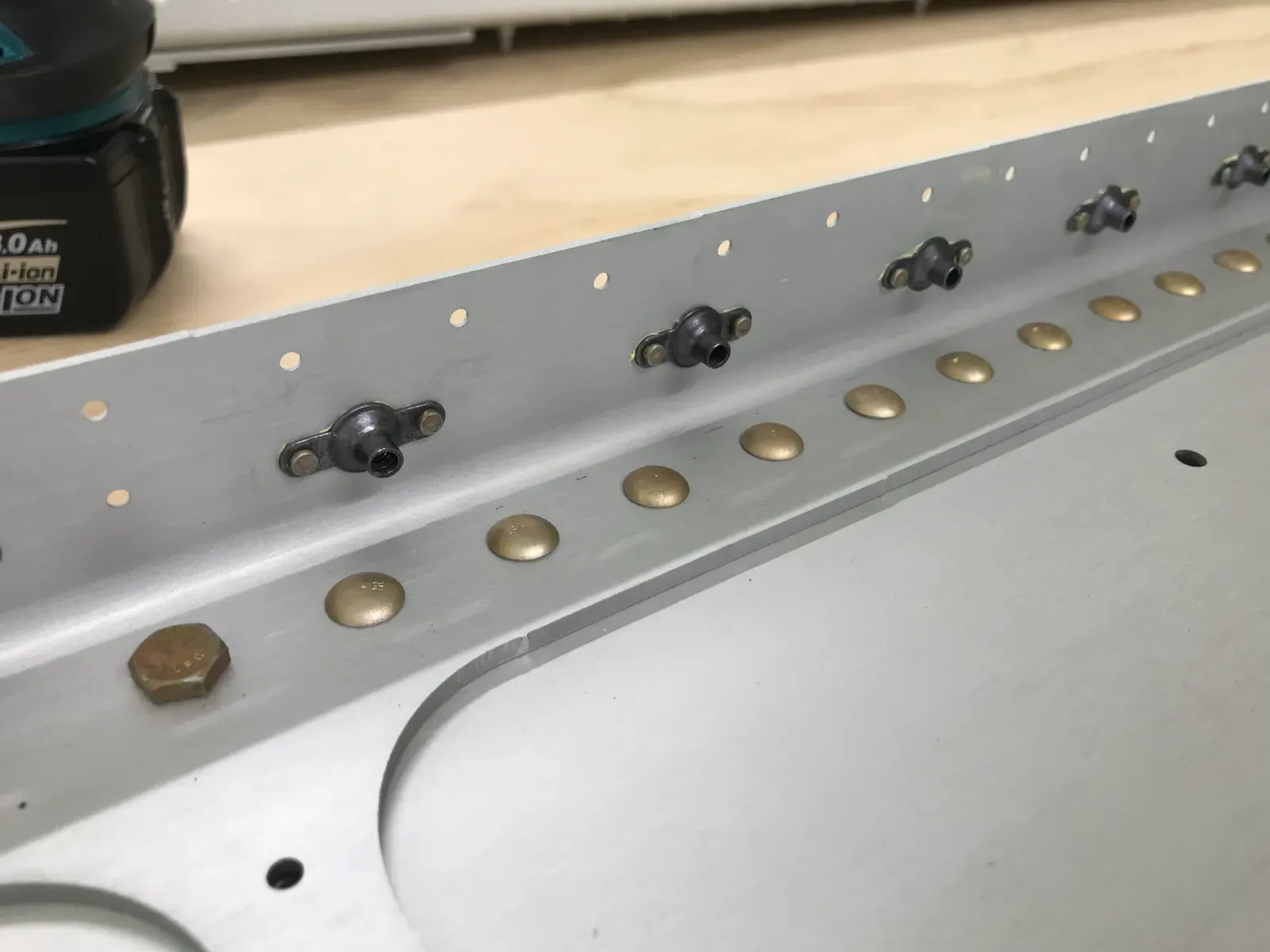
Since there are lots of nutplates, I needed an efficient system to secure them in the correct place for riveting. In the end what worked best for me was the following:
- Position all rivets along a row.
- Place on the nutplates.
- Clamp a nutplate.
- Drive a screw with a cordless drill just short of the countersink.
- Nip gently with a handheld screwdriver - avoiding damage to the priming!
- Remove clamp and apply to next nutplate ready for repeating the process.
- Rivet.
The placed rivets located the nutplate during screw insertion, and the clamp allowed a gentle pressure to be applied to prevent the screwdriver bit slipping in the screw head.
Gentle nip with a normal screwdriver.
Boelube
When I tried to insert a screw into a nutplate whilst secured in a vice as a test I discovered the screws were a VERY tight fit! A bit of research resulted in a …

Apply Boelube to the thread and it becomes much easier. I used this on the single screw I sacrificed to centre all the nutplates.
Setting
Rivets set with Pneumatic Squeezer.
During repeated squeezes … and there is a LOT of that … the set can rotate and hence go out of adjustment. Once the set is adjusted I mark the shaft and check/adjust frequently.
The result.
Phillips ACR Screwdriver Bit
ACR is a Phillips trademark, and means the screwdriver bit incorporates tiny grooves on the contact surfaces allowing a better “grip”.
The PH2 with ACR proved a perfect fit in the #6 & #8 nutplate screws ... even though a high torque was needed for each nutplate, no slippage occurred using this bit, and I only needed one screw per type of nutplate for the whole job. In fact the cross on the screw is completely undamaged! I think ACR stands for Anti Cam-Out Ribs.